


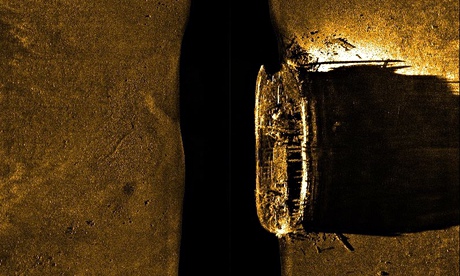
A sonar image of the ship on the sea floor in northern Canada. Photograph: AP
A British ship that disappeared in the Arctic more than 160 years ago has been found, helping to clear up an enduring historical mystery, the Canadian prime minister, Stephen Harper, announced on Tuesday.
The HMS Erebus and HMS Terror were last seen in the late 1845 when the British arctic explorer Sir John Franklin and 128 hand-picked officers and men vanished on an expedition to find the fabled Northwest Passage.
Their disappearance prompted one of history's largest and longest rescue searches, which lasted until 1859, but no sign of either ship was found.
Canadian divers and archaeologists had been trying since 2008 to find the ships, which became ice-bound off King William Island in the Victoria Strait in the Arctic territory of Nunavut.
Harper said: "This is truly a historic moment for Canada. This has been a great Canadian story and mystery and the subject of scientists, historians, writers and singers so I think we really have an important day in mapping the history of our country."
The mystery has gripped Canadians for generations, in part because of the crew's grisly fate. Inuit say the desperate men resorted to cannibalism before they died.
Harper's government began searching for Franklin's ships as it looked to assert Canada's sovereignty over the Northwest Passage, where melting Arctic ice has unlocked the very shipping route Franklin was after.
The original search for the ships helped open up parts of the Canadian Arctic for discovery back in the 1850s.
A ship was found on Sunday, using a remotely operated underwater vehicle, Harper said, although it remains unclear which vessel it is.
The discovery comes shortly after a team of archeologists found a tiny fragment from the Franklin expedition. Searchers discovered an iron fitting that once helped support a boat from one of the doomed expedition's ships in the King William Island search area.
Franklin's vessels are among the most sought-after prizes in marine archaeology. Harper said the discovery would shed light on what happened to Franklin's crew.
Tantalising traces have been found over the years, including the bodies of three crewmen discovered in the 1980s.
The bodies of two English seamen – John Hartnell, 25, and Royal Marine William Braine, 33 – were exhumed in 1986. An expedition uncovered the perfectly preserved remains of a petty officer, John Torrington, 20, in an ice-filled coffin in 1984.
Experts believe the ships were lost in 1848 after they became locked in the ice near King William Island and that the crews abandoned them in a hopeless bid to reach safety.
The search for an Arctic passage to Asia frustrated explorers for centuries, beginning with John Cabot's voyage in 1497. Eventually it became clear that a passage did exist, but was too far north for practical use. Cabot, the Italian-British explorer, died in 1498 while trying to find it and the shortcut eluded other famous explorers including Henry Hudson and Francis Drake.
No sea crossing was successful until Roald Amundsen of Norway completed his trip from 1903-1906.
CREDIT: THE GUARDIAN.COM

No comments:
Post a Comment